
What now ?
Now that we have written down our ingredients, we have to decide where we use them in the recipe. If you put the spaghetti in a hot pot with no water, chances are you are gonna starve. The next step is important since those ingredients are not gonna line up by themselves. There are multiple standards in this wild world we live in that you have to consider when designing a harness. Since we narrowed down our components earlier, it’s gonna help. For this street car project we are gonna use the original Lexus IS300 electrical system so we are going to go by Toyota’s standards.
Thick boi !
One of the things that people tend to go from one extreme to the other is wire type and gauge. Car brands use a wire that is both price wise and can last the time window they designed it for. It’s usually GXL and TXL or equivalents according to local engineering standards. It’s a good tough wire type that can last a long time fulfilling its purpose. That being said, some applications can be made better with more specialised wire types. The trademark name for the most common high end wire type is “Tefzel” that you may have read or heard about on high end performance cars. Due to its different stranding, jacket composition and design, you end up having a smaller, thinner, more heat resistant wire that can still outperform a bigger TXL / GXL wire. If you bundle many wires together, it makes a big difference on weight and actual room that the harness takes around the engine and components. The only downside to using Tefzel is that it’s around 2-3x the price of TXL / GXL. Less is more and the actual Lexus project is a good contender to showcase the difference Tefzel brings to a performance car.
Left, right, right, left … oh
Now that we know the type of wire we are gonna use, we have to decide the routing it’s gonna have to connect all components together. Again, the original routing can be reproduced and still give a good looking and functional outcome. If there is no reason to change component location and harness routing then it’s a no brainer. Sometimes it’s mandatory to modify the routing for many reasons. The ecu has a different shape, has different restrictions, ignition coils are different, sensors are more precise so they need a reading from a different place, the turbo setup is different and so on. At this point, your imagination is the limit but you have to keep in mind that changing the engineer’s work also means rethinking what issues can happen and how accessible or not you need your harness and components to be.
Do you have papers for that ?
It’s time to throw everything together and make it make sense. For many reasons documentation is essential. You prepare yourself to build something that is all hidden under a protection sleeve and does not move (hopefully). You have to make sure that everything is there during the process, when testing the final product and later for future upgrades or even diagnosis. We love having documentation when working on our cars and doing modifications or custom work should also be documented. In my case, I supply documentation when I make a harness so people are not lost because they use a product that has no support. Handwritten or made in a software, as long as you understand, it’s up to you. In general, I use a design software so I can track all my orders and easily tailor for customers who need something more specific.
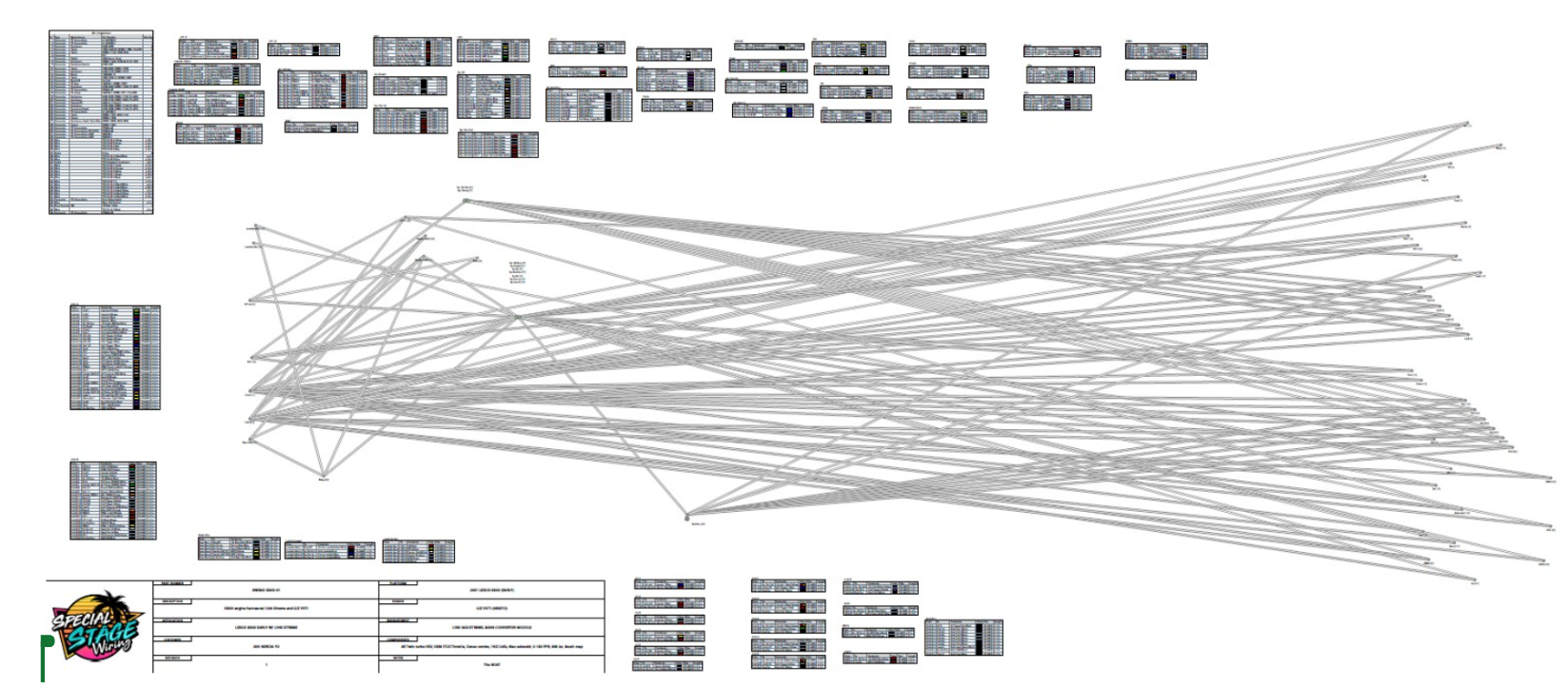
Now this feels good, we can finally breathe over this step being accomplished. It’s clear, easy to understand (hopefully) and to help me in my own process, this diagram is in actual 1:1 size. While someone could use a regular printer and stick all the sheets together on an assembly table, I have an architect printer and I print 3’x8’ plans from a paper roll. The next step is obviously laying down the wires to make the actual physical project now that we built our documentation.
Who would have thought that this harness would contain around 456 feets of spaghetti from all gauges and color ?