
Where Do You Start When Building a Custom Wiring Harness?
Let’s say you need a custom wiring harness for your engine, what is the first step ? Would it be buying wire and starting to crimp new connectors to it ? How do you decide what goes where ? How do you make sure everything is blended in your marvelous spaghetti before putting protection over it ? There are few courses in the real world about car electronics. While they help understand the major steps, there are still blank spaces to fill that will most likely be filled by experimenting. Connecting the dots takes time !
How is the tuna ?
Before laying the first wire, you need to know: What am I dealing with? Am I wiring a mower, a race car or a performance street car? What type of engine do I have and what are the components that make this engine alive ? Should you replace some of those with up to date components or should you keep them ? While those components might still look good you have to ask yourself: are they precise enough for what I want to do and are they in the good location for the changes I’m about to make ? So many questions but in the end, it’s important to address what components you have to narrow down how to manage them.
On white …
Now that you know about the components, you have to decide what brain is gonna be tasked to manage them. If you have a factory ECU that matches your engine that’s a plausible equation. If you have a modified engine it’s possible that this ECU won’t be able to deal with sensors and components outside the factory parameters. An aftermarket ECU might be the solution since they mostly are able to accommodate different components than factory ones. Being able to fine tune ignition and fuel is a common constraint on older factory ECU. It’s the key to unleash power and drivability through more efficient components fitted in and to the engine. In 2026 there are countless companies offering solutions but keep in mind that if the ECU doesn’t know there are new components, it can end in a vehicle with low to no drivability.
No crust ?
Maybe your engine doesn’t have a brain and is still managed in a pure mechanical way. It’s absolutely legitimate and only makes the engine harness more simple. A little update on the wires can’t hurt considering that it doesn’t have an ECU, it’s probably old (and cool). A common add-on to an old (and cool) vehicle is more and more … an ECU ! Some popular engines have a full plug and play system that can be fitted with very little modifications. It greatly simplifies day to day usage with an ECU that manages fuel and ignition by itself. If you have a rare vehicle but still think about putting it to 2026 standards, it can be done with slightly more work and will obviously need a fully customized engine harness.
Tuna on white, no crust !
Narrowing down the list of components and how to manage them is very helpful. You still need to make sure you are not gonna miss anything while actually building the harness. If engineers thought about making documents side by side with the physical harness, it has many reasons. Either to help you during the assembly process, testing and even years later diagnosing issues, you need documentation. When you think about all the components, how to feed them current, how to precisely control them, measure what is happening, when it’s happening … you realise there’s hundreds of wires totalizing hundreds of feet laid out in a vehicle … you need to know where they go and what they do. This is where it makes a difference. Preparation. 50% of the total time put in a custom wiring harness is documentation and design. It makes no sense to lay down wires if you don’t know what components you are gonna manage, where they are and how hungry they are. Using the wrong wire and wire size can produce performance issues and even catastrophic failures. Reading, taking notes, thinking about provisioning, testing and measuring are all parts of building documentation.
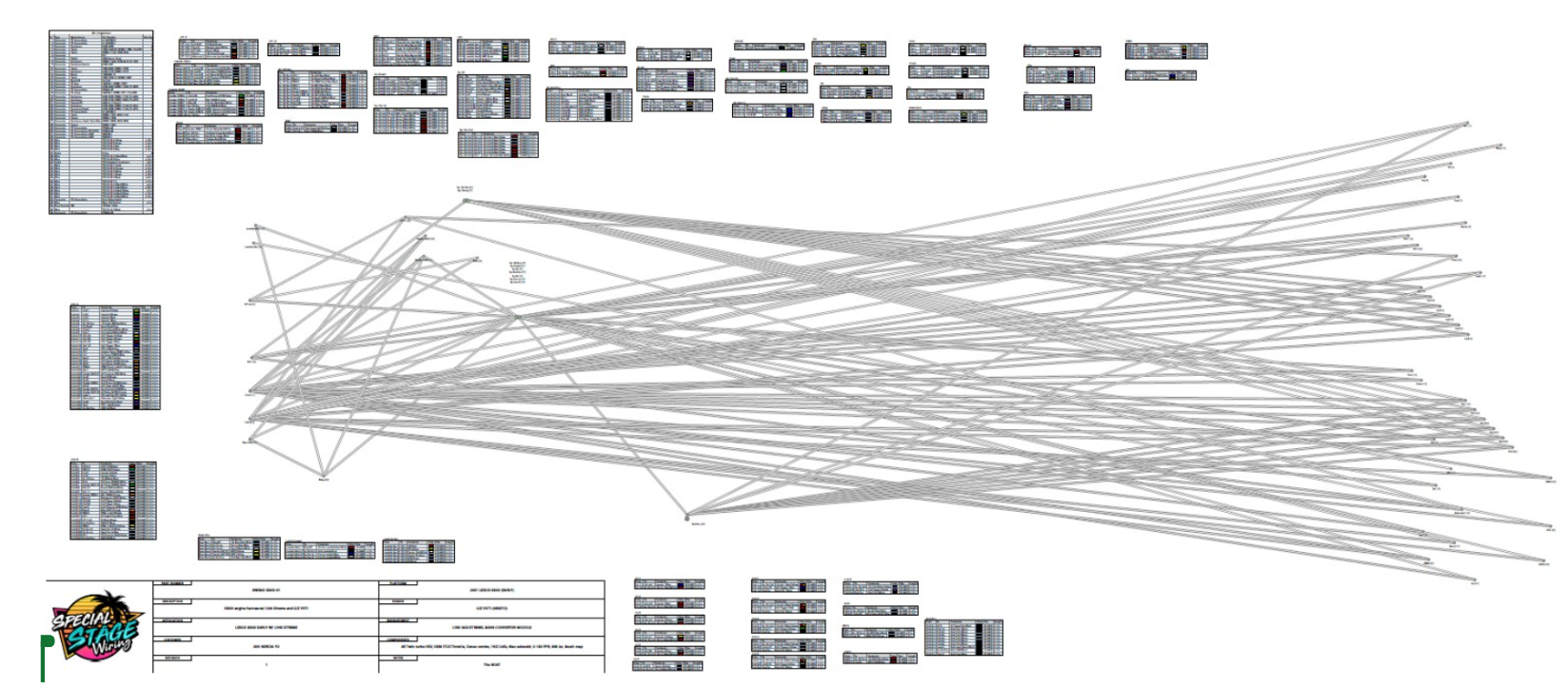
Take this Diagram for example. It’s a raw example of all components and their relation with the ECU and the car’s connections. There’s a lot of wires present to retain all of the car’s functionality while upping the game and sprucing out the power with efficient components. This is what many years of trial, error and experimenting does. While this is a major step in the whole harness building process, there is still a lot of work to be done. For now let’s digest and keep some room for the dessert.